Relational database management systems

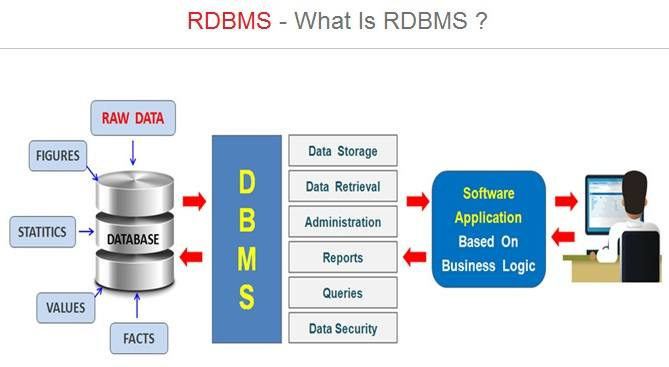
Traditional data management leveraged traditional relational database systems. A relational database management system (RDBMS) is a type of data storage technology that stores information in a relational structure. Typically, related data is stored in a table, and each table has columns of data elements that are related to each other and collectively form a row. The term "table" describes this two-dimensional construct of rows and columns that is used to store data that tends to be structured.
By "structured," we mean that each piece of data is well-known and understood and fits into a set of guidelines about its format and size. In a relational database, the data values in the tables are often "related" to values in other tables to minimize data redundancy. For example, imagine you were Amazon with millions of customers for whom you processed orders. You wouldn’t want to store the customer’s information about shipping address, preferences, payment methods, etc. In the orders table because most customers place several or even many orders, having to store the same information over and over again each time a customer placed another order would be both inefficient (wasting space) as well as difficult to manage (if the customer moves, then you wouldn’t want to go back and find every order shipped to the customer and update the shipping address information).
To make sure that this "related" data was kept consistent, these relational database systems adopted a set of principles for how to manage changes or additions to the data to make sure that all data was kept consistent at all times. Of course, by ensuring consistency, these database systems also created a lot of complexity and limited their scalability.
Computer scientists figured out that it would be just about impossible to keep the data consistent if the data were to be spread across multiple servers, so they decided to build a database that ran on a single server, and then they attempted to make that single server as large as possible so that it could accommodate large databases. This worked for a while, but as both the volume of data and the variety of data types have increased, the single-server database approach is reaching the end of its capabilities, and for many applications, it is no longer capable of accommodating the required data workload.